
Artist: Adam Ross
Title: Bring On The Apathy
Format: 12” green vinyl | digifile CD | digital
Cat#: Fika117
Release date: 15th May 2026
Bandcamp
Fika Recordings are pleased to present Bring On The Apathy, the third solo record from Scottish songwriter Adam Ross, out 15th May.
The album was recorded onto tape, using traditional analogue techniques at Glasgow’s Green Door Studio with Samuel J. Smith. It showcases some of the most emotionally open, lyrically deft and characterful songwriting so far from one of Scotland’s most accomplished writers. The vintage recording approach brings a warmth and intimacy to a record which is in equal parts raw and organic while also beautifully arranged and performed as Adam is joined by a raft of excellent collaborators.
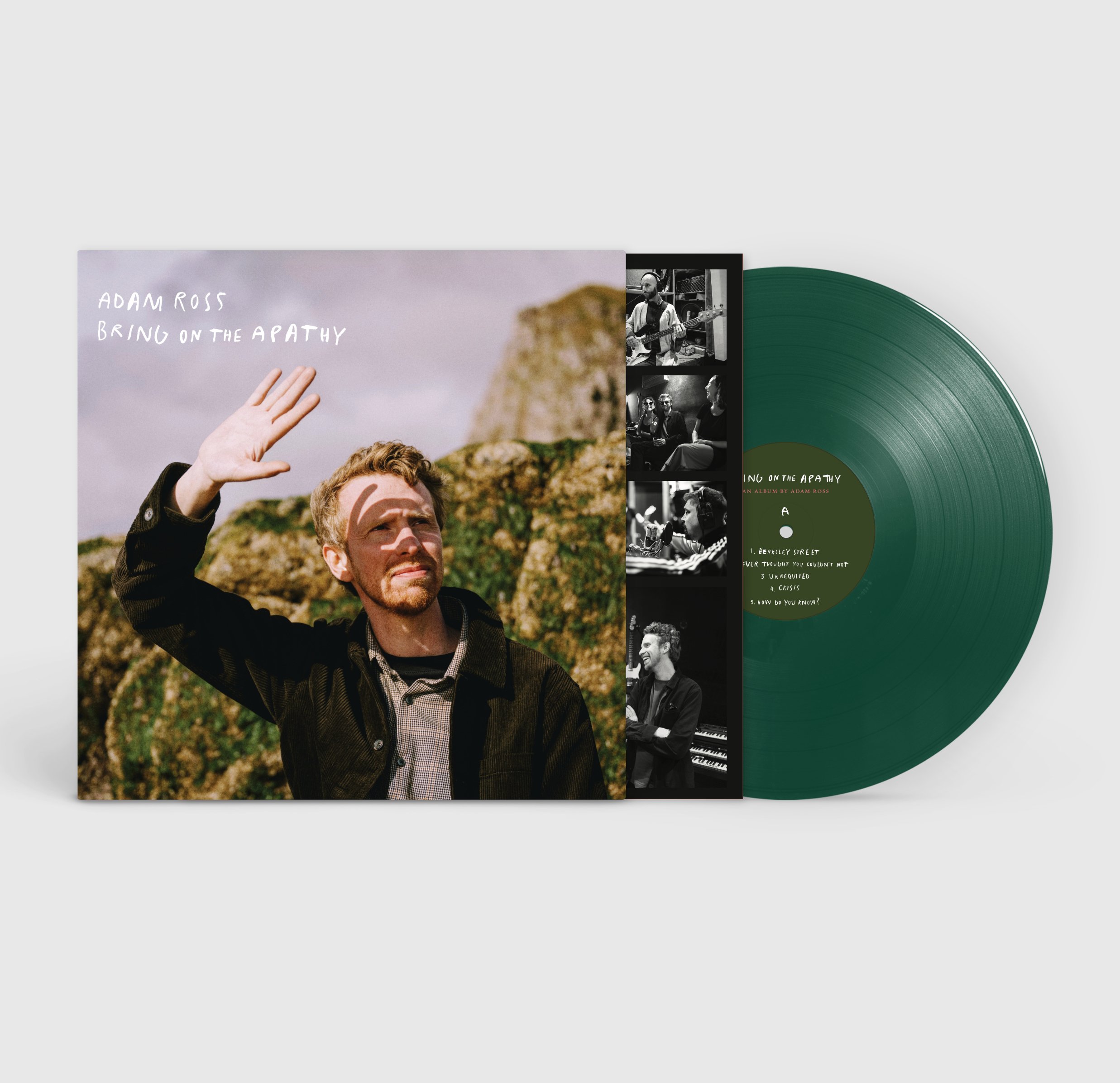
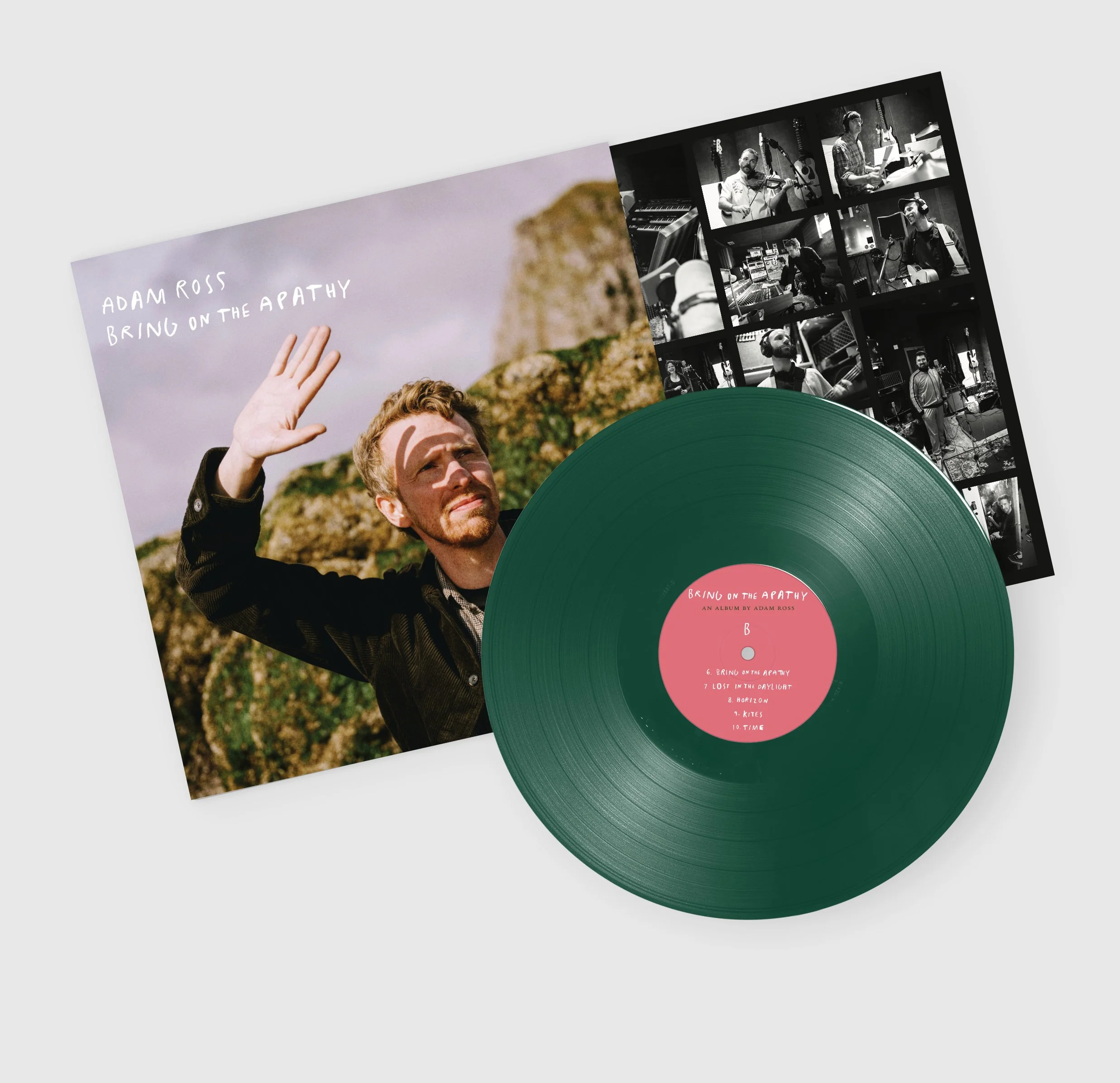
The album itself is a reaction. Whether it be in the title, the lyrical content or the method in which the sounds were captured, the listener will find elements of pushback from Adam against the world around him:
“I was feeling fairly down and uninspired about the musical landscape” Adam explains. “The risk with digital recording where every instrument is overdubbed separately is that it can end up sounding metronomic, sterile and lacking personality or a sense of space. I also started to get a bit freaked out by the topic of AI-generated music and the insidious, creeping impact it’s already having. I therefore decided that, as a bit of a protest, I wanted to make something that sounded extra-specially human and hand-crafted, where you could hopefully hear the interplay between musicians.”
For this reason, Adam decided to record the majority of the album live, as a band, playing together in the same room without a click track. “I’d put a band together to tour my last album, Littoral Zone, and I really enjoyed the way we all worked together. I don’t like to micro-manage rehearsals or over-arrange songs and I realised that everyone in the band is very creative and instinctive, rather than being robotic “session musicians”. They’re all great at improvising and adding ideas without ever impinging or encroaching on what the song is trying to convey. I was really keen to capitalise on this with the new record and it suddenly became very clear that an analogue studio would be the ideal way to capture these little connections in a way that felt intimate and authentic.”
Green Door Studio was chosen as the destination as it specialises in analogue sound production but it had an extra significance for Adam. “Green Door was the first studio I ever recorded in, back in 2009. My band Randolph’s Leap got a demo-development grant and we recorded our first EP there. The band had never actually been in the same room as each other and we were very naïve and unprepared. Recording to tape can be quite unforgiving and, in truth, we probably weren’t ready for it. It took me 16 years to build up the experience and courage to go back!”
This time around, the “unforgiving” nature of tape recording became an inspiration. “The musicians on the record are such great players that they rarely make mistakes, so there was a confidence there that we wouldn’t need to rely on copious amounts of editing or post-production, which isn’t always possible with tape anyway. If the songs sped up or slowed down a bit or you heard the piano stool creak or someone breathing then that was all fine. I wanted it to sound as natural and “real” as possible. The vintage equipment brings a delicious amount of depth to things like the drums. I’m not sure I can go back to digital now!”
The core band consisted of Owen Curtis-Williams on drums, Cameron Maxwell on bass, Pedro Cameron on violin, Gillian Fleetwood on harp and (long-time collaborator with Randolph’s Leap) Pete MacDonald on piano. Mercury Prize-nominated artist C Duncan was drafted in to write and perform backing vocal arrangements along with Amanda Nizich and Gillian Fleetwood.
Adam says “I made this album for myself and tried not to second-guess things when it came to stylistic choices. I’d been listening to a lot of Bob Dylan, Karen Dalton and Bill Callahan records and I thought it might be interesting to apply those sorts of influences to my brand of Scottish quirk-pop”.
The title, ‘Bring On The Apathy’, sums up the mood surrounding the creation of the album. “I couldn’t get away from the sense that people are feeling quite jaded. I think it’s a natural response to the way the world is right now. There’s obviously a much wider, societal aspect to that idea, but it also relates directly to the way I feel about releasing music nowadays. There are lots of highs and many beautiful, rewarding moments that come from it but the act of promoting and marketing an album can be incredibly demoralising at times. It’s a fact that the majority of people will have nothing but apathy for the creative thing you’ve spent years cultivating and that’s totally understandable but, you know, it can be tiring. I think apathy is a big reason people decide to stop making art. So the title is meant to be empowering. It’s about recognising the abundance of apathy in the world and trying to inure myself to it and get some kind of control and power over it.”
While those feelings of weariness and even cynicism are noticeable in the lyrics of the songs, Adam says, “I hope there’s plenty of positivity and optimism to be found in there too. I wanted there to be lots of grey areas rather than binary emotions though. There’s also a lot of playfulness and provocation in the words. I don’t necessarily mean everything I sing.”
The sense of bittersweet melancholia is also tied in with another key theme of the record: aging. The album opens with Berkeley Street, a twisting and turning collection of snatched memories from Adam’s time living in Glasgow in his 20s. He has since relocated to St Cyrus, an Aberdeenshire village on the north-east coast. “I was in Glasgow for a Celtic Connections gig in January 2025. It was unseasonably warm and I was wandering the streets around where I’d lived over a decade earlier. It all felt entirely familiar but I bumped into a guy I used to know and his hair had turned grey since I last saw him. Now, I’ve got nothing against grey hair of course, but it was a clear reminder of the pesky old passage of time.”
The closing track is, appropriately enough, entitled Time and examines the idea of purpose. “It’s something I didn’t think about much until recently. I’m quite good at living in the moment but as I reach my mid-late 30s I’m much more prone to a bout of existential dread.”
Self-interrogation threads its way throughout the album. “Is this a midlife crisis or is it art?” asks Adam on Crisis while I Never Thought You Couldn’t Not asserts that the path to success is “littered with the bodies of the easily distracted and the self-aware.”
However, despite the ennui, Adam is keen to state that he has no intention of giving up. “Songwriting is a form of therapy. It’s good to explore these feelings and get them out there. I feel much better for it and, on the whole, music-making is a joyful thing for me. I’ve still got plenty of optimism and I’m already pouring it into new songs. I’m really proud of this record. It’s my favourite thing I’ve ever made. I hope people like it. Bring on the apathy.”
Pre-release praise for Bring On The Apathy:
"Masterful songwriting, memorable hooks and melodies at every turn, delicate arrangements and knowing and wise lyrics. A wonderful album. Highly recommended." - Norman Blake (Teenage Fanclub)
"Adam's music and songwriting comfortably inhabits the sweet spot between Edwyn Collins and The Beautiful South, and this album captures him in fine, fine form" - James Yorkston
"A clutch of literate and thoughtful new songs from Adam Ross, dressed in tasteful arrangements that revel in a rich chamber pop tradition. Adam’s lyrics are singular, raising eyebrows, smiles and spirits, usually in the same song." - Withered Hand